
What Muscles Does a Recumbent Bike Work? The Complete Breakdown
The comfort of a recumbent bike’s supportive seat often raises a crucial question: Is this low-impact workout truly effective, and what muscles am I actually working?
A recumbent bike offers a powerful, low-impact seated cycling workout that primarily focuses on strengthening and toning the major lower-body muscle groups: the quadriceps, hamstrings, and glutes.
This comprehensive guide provides a detailed, muscle-by-muscle breakdown of the recumbent bike workout, analysing how the unique riding position affects muscle engagement, and offers tips to maximise every revolution for strength and endurance.
Key Takeaways
- The recumbent bike is highly effective for building strength and endurance, primarily targeting the quadriceps, hamstrings, and glutes—the ‘pedal pushers’ of the lower body.
- The reclined, supported position ensures the workout is low-impact and joint-friendly, making it ideal for rehabilitation or users with back/joint concerns.
- The recumbent bike’s horizontal design focuses primarily on the powerful ‘push’ phase of the pedal stroke, offering an excellent opportunity to specifically strengthen the glutes and hamstrings.
- Unlike an upright bike, the recumbent position provides full back and arm support, meaning minimal engagement of the core and upper body; it is not a full-body workout.
- To maximise strength gains, you should increase the resistance and focus on a smooth, controlled pedal stroke.
Contents
- Recumbent Bike – Key Muscle Groups Explained
- Secondary and Stabilising Muscles
- How the Recumbent Position Changes Muscle Engagement
- Tips for Maximising a Workout on a Recumbent Bike
Detailed Definition
In this article, we’ll be discussing key muscle groups, and with that come some key terms. If you are unfamiliar with some of these phrases, it may become confusing, which is why we have included simple definitions for your reference below.
Key Terms
- Prime Movers: The main muscles responsible for executing a specific movement (in this case, pedalling).
- Stabilisers: Muscles that maintain a steady posture and support the body during a movement.
Recumbent Bike – Key Muscle Groups Explained
The foundation of a recumbent bike workout lies in the powerful muscles of your legs. These are the ‘Prime Movers’ responsible for generating all the force.

1. Quadriceps (Quads)
- The Role: The four muscles at the front of your thigh are the central engine of the workout. They are responsible for extending the knee and pushing the pedal away from your body in the downward phase of the stroke.
- Focus: They are heavily engaged in every single revolution, making the recumbent bike an excellent tool for quad strength and definition.
2. Gluteal Muscles (Glutes)
- The Role: Comprising the gluteus maximus, medius, and minimus, the glutes are engaged during the powerful ‘push’ phase of the stroke, driving the pedal down.
- Focus: The supported, reclined position allows your back to remain stable and strong, enabling a more focused and stable push. This makes the recumbent bike a surprisingly effective exercise for direct glute engagement.
3. Hamstrings
- The Role: Located at the back of the thigh, the hamstrings work in tandem with the glutes. They assist in extending the hip and help to pull the pedal up and back towards the body.
- Focus: While the push is dominant, the hamstrings are essential for the back half of the stroke and for controlling the movement as your leg recovers for the next push.
4. Calves
- The Role: The muscles in the lower leg, including the gastrocnemius and soleus, assist the main movers. They are particularly active as you transition through the bottom of the pedal stroke, helping with overall power transfer.
Secondary and Stabilising Muscles
Though not the focus, several other muscles play important roles in maintaining form and assisting the motion.

1. Abdominals (Core)
- The Role: While far less engaged than on an upright bike (where they maintain balance), the abdominals and lower back muscles still act as stabilisers.
- Focus: They help maintain proper posture and a stable pelvis, especially when you increase resistance and exert more effort.
2. Tibialis Anterior
- The Role: This often-overlooked muscle runs along the front of your lower leg, specifically the shin. It’s responsible for lifting the foot and is active in the recovery phase of the pedal stroke.
- Focus: Its engagement demonstrates the deep, expert-level understanding that the recumbent bike involves the entire lower leg, not just the large muscle groups.
How the Recumbent Position Changes Muscle Engagement
The key difference between a recumbent and an upright bike is the seated angle, and this dramatically alters the dynamics of the workout.

The “Push, Not Pull” Dynamic
In the horizontal, recumbent position, the pedal stroke tends to primarily emphasise the powerful push phase.
- Upright Bike: The rider is typically positioned over the pedals, allowing them to engage in a more circular “push and pull” dynamic, where pulling up on the pedal is a key part of the movement.
- Recumbent Bike: The reclined position encourages a forward-thrusting motion, focusing the effort on the quadriceps, glutes, and hamstrings during the initial power stroke. This makes it superb for isolating and strengthening these core leg muscles.
Reduced Upper Body and Core Work
It’s important to be direct and honest: the recumbent bike does not engage the core and upper body in the same way as an upright bike.
- This is because the back and arms are fully supported; your core, shoulders, and arms are not needed for balance or to hold yourself upright.
- The Benefit: This is precisely why it is so comfortable and is the machine of choice for those recovering from injury or experiencing back pain.
- The Trade-Off: For a full-body workout, you would need to combine your recumbent session with strength training.
Tips for Maximising a Workout on a Recumbent Bike
Understanding the muscles is the first step; the next is learning how to push them harder to achieve your fitness goals.
1. Increase Resistance
This is the single most effective way to build lower-body strength. Higher resistance forces your quadriceps and glutes to contract harder with every push, resulting in a greater muscular challenge and increased strength gains.
2. Vary Your Pace (Intervals)
Incorporate interval training: alternate between periods of high-resistance/fast pedalling (challenging your speed and power), followed by slow, low-resistance recovery periods. This not only improves cardiovascular fitness but also builds muscular endurance.
3. Focus on Form and Power
Encourage a smooth, controlled pedal stroke. Avoid “mashing” the pedals—instead, focus on a deliberate, powerful push through the full range of motion. Pay attention to how your glutes and hamstrings feel when you push, ensuring the power comes from your leg, not just your ankle.
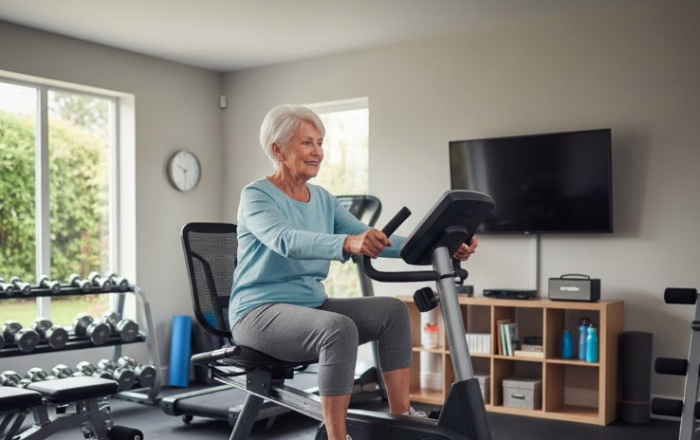
Get the most from your recumbent bike with FitKit UK
The recumbent bike is far more than just a comfortable option; it is a powerful tool for low-impact exercise. By providing a stable, supported platform, it efficiently targets and strengthens the glutes, hamstrings, quadriceps, and calves with every revolution. By understanding which muscles you are targeting, you can tailor your workouts—by increasing resistance and varying your pace—to confidently achieve your specific fitness goals. Get ready to pedal and push your way to stronger legs with our selection of recumbent bikes at FitKit UK.
Related Posts
Comments are closed here.