
A Low-Intensity Workout to Start Your Fitness Journey

For many beginners, the fear of “starting too hard”—resulting in injury, severe muscle soreness, or sheer exhaustion—is the biggest barrier to entering the world of fitness.
A low-intensity workout is a gentle, steady-state training session where your effort levels remain moderate (roughly 50-70% of your maximum heart rate), allowing you to move for longer without fatigue.
In this guide, we will break down exactly what defines low-intensity exercise, the massive benefits it holds for your long-term health, and provide a simple 20-minute home circuit to get you moving safely today.
Key Takeaways:
- Consistency over intensity: A low-intensity workout prioritises sustainable movement over exhaustion, making it easier to stick to a routine.
- The “Talk Test”: If you can hold a conversation while moving, you are in the correct zone for fat metabolism and building stamina.
- Safety first: Starting with low-impact movements significantly reduces the risk of injury, ensuring you don’t burn out in week one.
Jump To:
- What defines a low-intensity workout?
- What are the benefits of low-intensity workouts?
- Beginner-friendly low-intensity routine ideas
- How often should I do low-intensity workouts?
- The Low-Intensity 20-Minute Home Circuit
What defines a low-intensity workout?
To understand what a low-intensity workout is, we need to ignore the “no pain, no gain” mentality. Low intensity does not mean “easy” or “lazy”; it means purposeful control.
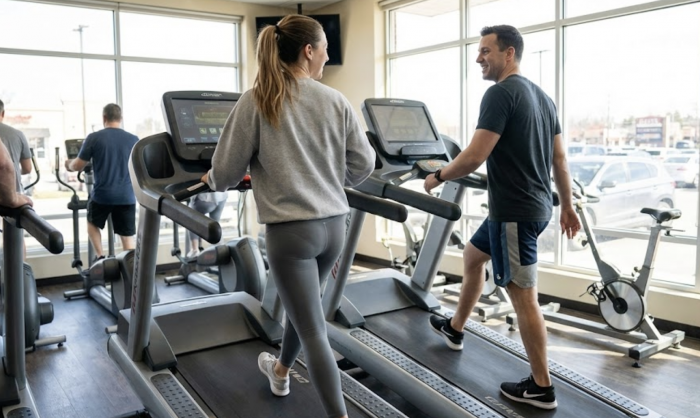
The Talk Test: The simplest way to define this without complex heart rate monitors is the “Talk Test.” During a low-intensity workout routine, you should be breathing heavier than normal, but still able to speak in full sentences without gasping for air. This is often referred to technically as “Zone 2” training.
What are the benefits of low-intensity workouts?
1. Builds Your Aerobic Base
Think of your fitness like a house. Low-intensity exercise builds the foundation. It increases the efficiency of your heart and lungs, creating a base that allows you to handle harder workouts in the future without burnout.
2. Aids Fat Metabolism
When you work at a lower heart rate, your body primarily uses stored fat as fuel rather than carbohydrates. This makes low-intensity work highly efficient for body composition changes over time.
3. Promotes Active Recovery
If you are feeling stiff, total rest isn’t always the answer. Gentle movement increases blood flow to muscles, helping to flush out metabolic waste and speed up recovery without adding new stress.
4. Reduces Injury Risk
This is crucial for beginners. By keeping the impact and intensity low, you allow your tendons, ligaments, and joints to adapt to new movement patterns gradually. It avoids the “too much, too soon” injuries that stop many journeys before they truly begin.

Beginner-friendly low-intensity routine ideas
You can perform a low-intensity workout using equipment or just your body weight. Here are the most effective methods to get started.
Cardio Equipment Options
If you have access to gym equipment, these machines are ideal for controlling your pace:
- Elliptical Trainer: Excellent for protecting knees and hips, as there is zero impact.
- Exercise Bike: Offers precise control over resistance—keep the pedals turning at a steady rhythm.
- Treadmill (Brisk Walking): You don’t need to run. Set the incline to 1-2% and walk at a pace where you feel warm but comfortable.
Swimming / Water Aerobics
Water supports your weight, taking the stress off your joints entirely, while the water resistance engages your muscles.

How Often Should I Do Low-Intensity Workouts?
One of the greatest advantages of low-intensity exercise is that it is gentle enough to be performed frequently. Because you aren’t pushing your muscles to failure, your recovery time is much faster than with high-intensity interval training (HIIT) or heavy weightlifting.
- For Absolute Beginners: Aim for 3 days a week. This allows for a rest day in between sessions to let your body adjust to the new activity.
- The “Active Every Day” Goal: As you build stamina, you can safely increase this to 5 days a week.
- Duration: Start with just 20 minutes (like the circuit outlined below). As your fitness improves, try to extend your sessions to 30 or 45 minutes rather than increasing the speed.
Remember: Consistency is the key to results. It is better to do three 20-minute walks every week for a year than to run a marathon once and quit because it hurt!
The Low-Intensity 20-Minute Home Circuit
No kit? No problem. Perform each exercise for 45 seconds, rest for 15 seconds, and repeat the full circuit four times.
- Marching in Place: Swing your arms naturally and lift your knees high to get the heart rate up gently.
- Bodyweight Squats: Stand with feet shoulder-width apart. Lower your hips back and down as if sitting in a chair. Only go as deep as is comfortable.
- Wall Push-Ups: Stand an arm’s length from a wall. Place palms on the wall and lower your chest toward it, then push back. This builds upper body strength without the strain of floor push-ups.
- Glute Bridges: Lie on your back with knees bent and feet flat. Lift your hips toward the ceiling, squeezing your glutes at the top, then lower slowly.
- Arm Circles: Stand tall and make large, slow circles with your arms—30 seconds forward, 30 seconds backwards. This particular movement is great for shoulder mobility.
The Recovery Cool-Down
Finish your session with 3-5 minutes of light movement and static stretching. Focus on slowing your breathing and holding gentle stretches for your hamstrings and chest.
Signs you are doing a low-intensity workout correctly
It can be difficult to know if you are working hard enough or too hard. Here is a quick checklist to ensure you are in the right zone during your session:
- You feel warm, not “on fire”: You should feel your body temperature rise and perhaps develop a light sheen of sweat, but you shouldn’t be dripping or overheating.
- No “muscle burn”: That stinging sensation in your muscles (lactic acid) is a sign of high intensity. If your legs or arms start to burn intensely, slow down.
- Controlled breathing: As mentioned in the “Talk Test,” your breathing should be rhythmic and deeper than usual, but never frantic.
- You feel energised afterwards: A low-intensity workout should leave you feeling refreshed and accomplished. If you feel absolutely drained or need a nap immediately after, you likely pushed the intensity too high.
Step into the world of fitness you enjoy with FitKit
A low-intensity workout is the safest, most sustainable way to launch your fitness journey. It builds your aerobic health, metabolises fat, and keeps you injury-free, proving that you don’t need to suffer to make progress.
Ready to move? If you are looking for a way to stay active at home comfortably, browse our collection of beginner-friendly cardio equipment designed for low-impact training.
For more information and beginner-friendly fitness guides, make sure to check out our blog, which offers a wide range of beginner resources.
Comments are closed here.