
Can You Lift Heavy At Home? Big Barbell Exercises
Key Takeaways
- Compound Over Isolation: Focusing on the “Big Five” ensures a time-efficient, highly metabolic barbell full-body workout at home.
- Safety First: Never bench press or squat heavy at home without properly adjusted safety spotting arms.
- Invest in Quality: Proper rubber bumper plates protect your subfloor, reduce noise pollution, and extend the lifespan of your barbell.
- Progressive Overload: Track your lifts. To build maximum strength, you must systematically increase the weight, reps, or sets over time.
Jump To:
- Home Gym Constraints and Their Fixes For Heavy Lifting
- The Big Five Barbell Exercises at Home
- FAQs
- Equipment You Need To Lift Heavy at Home
Embracing barbell training at home is one of the most efficient ways to build raw power, functional mass, and bone density. By focusing on compound movements that recruit multiple muscle groups at the same time, you can execute a highly effective barbell full-body workout at home without needing to take up lots of space or a gym membership.
To help you transform your home gym into a space where you can lift heavier weights, this comprehensive guide breaks down the “Big Five” compound lifts while addressing the unique constraints of home training.
Home Gym Constraints and Their Fixes For Heavy Lifting
Setting up a home gym requires more than just knowing how to lift; you must also manage the safety and structural elements of your home. Here are some of the main considerations:
- Floor Loading Capacities: Heavy deadlifts and squats put substantial stress on residential floors. If you are training in a garage or ground-floor room with a concrete base, you are generally safe. For upper-floor flats or timber-framed rooms, consider structural load limits and invest in heavy-duty gym flooring to distribute weight evenly.
- Sound Dampening with Bumper Plates: Maintaining a good relationship with family and neighbours requires sound reduction. Standard cast-iron plates clash loudly and can damage flooring. High-grade rubber bumper plates are designed to absorb shock and drastically reduce noise, allowing you to drop deadlifts or execute Olympic movements smoothly.
- Rack Safety Spotting Arms: When lifting heavy without a human spotter, safety is non-negotiable. A premium half-rack or full-power cage equipped with adjustable safety spotting arms or flip-down safeties ensures that if you fail on a heavy squat or bench press, the rack catches the load, protecting both you and your home.
The “Big Five” Barbell Exercises at Home
To maximise muscle growth, your training must focus on mechanical tension and progressive overload (gradually increasing the weight or the number of repetitions). These five fundamental movements form the bedrock of any serious strength protocol.
1. The Conventional Deadlift
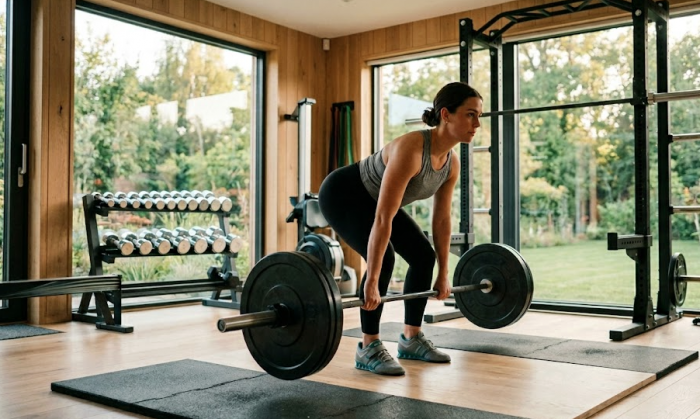
- Primary Targets: Posterior chain (hamstrings, glutes, lower back, traps).
- Why it matters: The ultimate test of raw pulling power and one of the most effective back exercises at home with barbell equipment.
- Technical Execution:
- Walk up to the bar, positioning your feet hip-width apart with the barbell cutting directly across the middle of your feet.
- Hinge at your hips and bend your knees slightly to grip the bar just outside your legs.
- Flatten your back, drop your hips slightly, and engage your lats by imagining you are trying to bend the bar around your shins.
- Drive the floor away with your feet, keeping the bar perfectly straight and close to your body as you stand up. Lock out your hips at the top without hyperextending your lower back.
2. The Back Squat
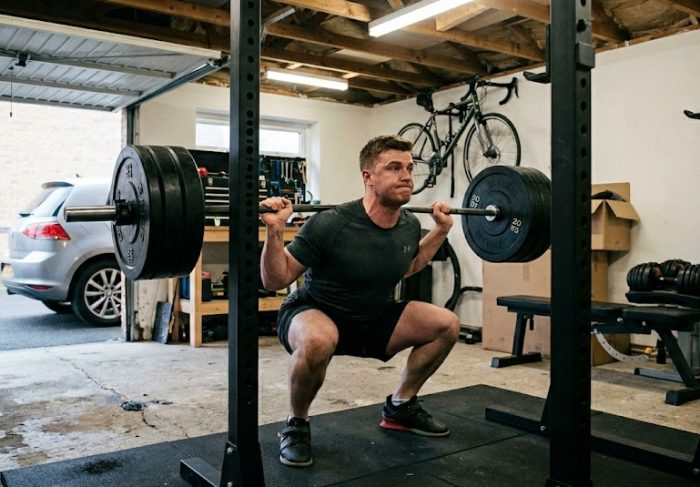
- Primary Targets: Quadriceps, glutes, hamstrings, and core.
- Why it matters: The undisputed king of lower-body development.
- Technical Execution:
- Rest the barbell securely across your upper traps (high-bar) or rear delts (low-bar) inside your safety rack.
- Step back, placing your feet just wider than shoulder-width apart, toes pointing slightly outward.
- Take a deep diaphragmatic breath, brace your core, and initiate the movement by sitting your hips back and bending your knees.
- Descend until your thighs are at least parallel to the floor, ensuring your knees track in line with your toes. Drive through your mid-foot to return to the starting position.
3. The Flat Bench Press
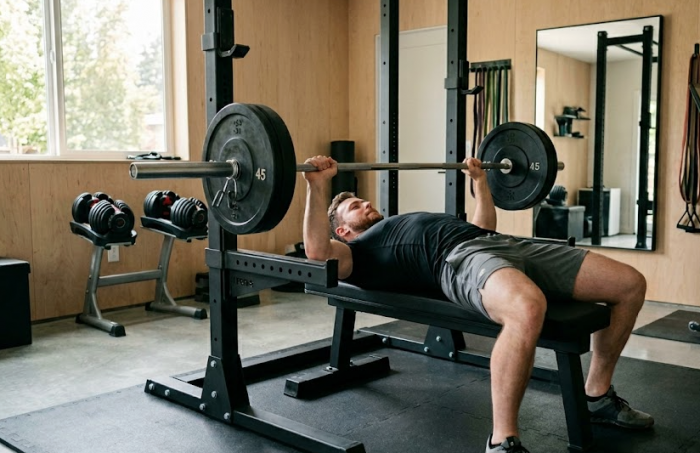
- Primary Targets: Pectoralis major, anterior deltoids, triceps.
- Why it matters: The definitive standard for upper-body pushing power and the cornerstone of chest exercises at home with barbell routines.
- Technical Execution:
- Lie flat on your bench, ensuring your feet are planted firmly on the floor to create a stable base.
- Grip the barbell slightly wider than shoulder-width. Pull your shoulder blades back and down into the bench to protect your rotator cuffs.
- Unrack the bar and guide it directly over your chest. Lower the bar under strict control to your mid-chest, keeping your elbows tucked at roughly a 45-degree angle.
- Push the bar forcefully back up to the starting position, maintaining leg drive throughout the lift.
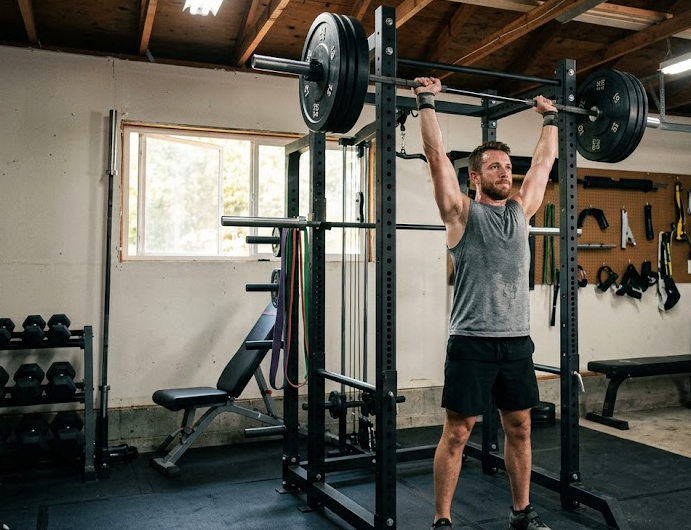
4. The Overhead Press
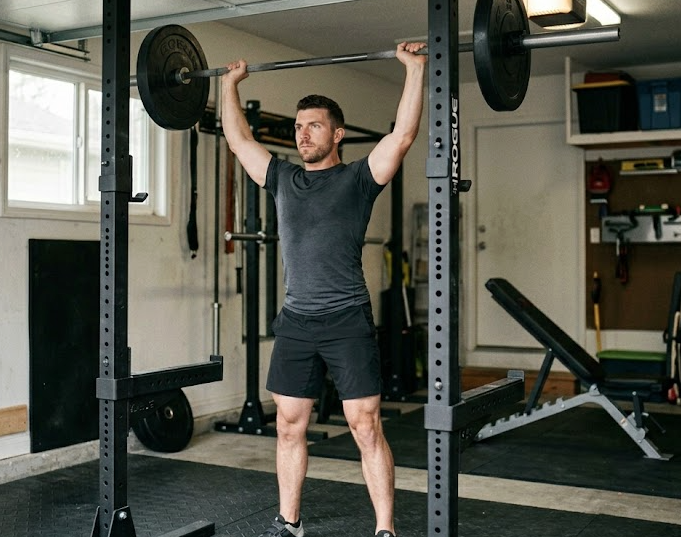
- Primary Targets: Deltoids, triceps, upper chest, and core stabilisation.
- Why it matters: An exceptional barbell shoulder workout at home that tests total-body rigidity.
- Technical Execution:
- Set the barbell at chest height on your rack. Grip the bar just outside shoulder width with your forearms perfectly vertical.
- Unrack the bar, step back, and squeeze your glutes and quads tightly to create a rigid foundation.
- Pull your chin back slightly and press the bar vertically overhead in a straight line.
- Once the bar clears your forehead, push your head forward (“pushing through the window”) to lock out the weight directly over your shoulder joints.
5. The Bent-Over Barbell Row
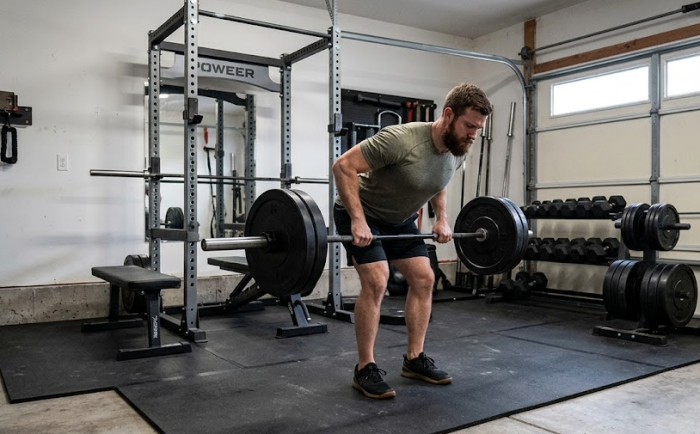
- Primary Targets: Latissimus dorsi, rhomboids, rear deltoids, and erector spinae.
- Why it matters: Balances out pressing movements and completes your library of back exercises at home with barbell training.
- Technical Execution:
- Stand over the barbell with a shoulder-width stance. Hinge at your hips until your torso is roughly at a 45-degree angle (or parallel to the floor for a Pendlay style), keeping your spine completely neutral.
- Grip the bar with an overhand or underhand grip.
- Pull the barbell toward your lower ribs by driving your elbows back toward the ceiling, squeezing your shoulder blades together at the peak of the movement.
- Lower the weight under control without letting your torso change angle.
Frequently Asked Questions
Can I build elite strength using only barbell exercises at home?
Absolutely. The human body responds to mechanical tension, not to its location. A high-quality barbell, a robust rack, and a set of plates allow you to execute the same heavy compound movements used by professional athletes and powerlifters worldwide.
Do I need a gym floor mat when using bumper plates?
Yes. While bumper plates are designed to absorb shock, they should always be used in tandem with specialised rubber gym flooring (ideally 20mm to 40mm thickness for deadlifts). This dual layer protects the concrete or timber beneath it from cracking over time from repeated impacts.
What is the best way to structure a barbell full-body workout at home?
An excellent approach is an alternating “A/B” full-body split performed 3 days a week.
- Workout A: Back Squat, Bench Press, Barbell Row.
- Workout B: Deadlift, Overhead Press, Chin-ups (or a secondary leg movement like lunges).
How much space do I need to safely use a standard 7ft Olympic barbell in a home gym or spare room?
To comfortably train with a standard 7ft (213cm) Olympic barbell, your room width needs to be at least 11 feet (approx. 3.35 metres). While the bar itself is 7 feet long, you need at least 2 feet of clearance on each side to safely load and unload weight plates without hitting walls, furniture, or door frames. For overhead movements, ensure your ceiling height is at least your standing height plus the length of your arms and an additional 6 inches for plate clearance.
Should I buy iron plates or rubber bumper plates if I only plan to do powerlifting movements like bench press and squat?
If you are strictly powerlifting (Squat, Bench, Deadlift) inside a power rack with safety arms, cast iron or machined steel plates are perfectly fine and often preferred because they are thinner, allowing you to fit more weight on the bar sleeve. However, if you plan to deadlift without a dedicated platform, or if you ever want to venture into Olympic weightlifting (cleans, snatches) where the bar is dropped from overhead, rubber bumper plates are non-negotiable to protect your floor and the barbell itself.
Equipment You Need To Lift Heavy at Home
To safely execute a heavy barbell protocol at home, you need robust equipment engineered to withstand immense mechanical tension. Here is the essential checklist for your setup:
1. Power Cages & Racks
Your virtual spotter. A solid rack allows you to unrack weights at optimal heights and catches the barbell if you miss a rep.
- Full Power Cages: The safest option, letting you lift inside a secure steel frame with adjustable safety arms.
- Half Racks: A space-saving alternative that still features front-facing spotter bars and built-in plate storage.
2. The Olympic Barbell
Do not compromise here. Standard 1-inch bars bend under heavy loads. Invest in a 7ft, 20kg Olympic Barbell with a 50mm sleeve diameter. Look for a tensile strength of 190,000+ PSI to ensure it stays straight, and choose a Cerakote or stainless steel finish to prevent rust in cold garages.
3. Olympic Weight Plates
Your choice of plates dictates how much noise you make and how long your floor lasts:
| Plate Type | Best For | Key Advantage | Home Gym Trade-off |
| Rubber Bumper Plates | Deadlifts, Rows | High shock absorption protects floors and reduces noise. | Thicker profile; fewer plates fit on the bar. |
| Cast Iron / Steel Discs | Bench Press, Squats | A thinner profile allows for maximum weight loading. | Very loud; can crack concrete without floor protection. |
4. Heavy-Duty Adjustable Bench
A stable bench press requires a rock-solid foundation. Choose an adjustable bench (Flat/Incline) built with thick steel and a combined user-and-load capacity of at least 350kg to eliminate wobbling under heavy weight.
5. High-Density Rubber Flooring
Never drop weights onto bare concrete or carpet. Interlocking rubber gym mats with a minimum thickness of 20mm are vital for absorbing impact, protecting your property, and dampening vibrations before they reach your neighbours.
Product Spotlight: Jordan Fitness 40mm EPDM Gym Flooring Tile
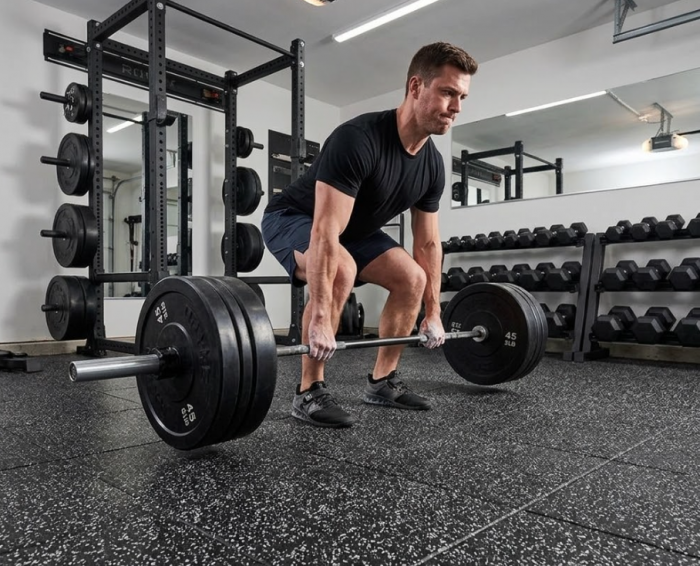
The ultimate solution for heavy lifting at home. This commercial-grade tile outperforms standard mats at protecting your subfloor, equipment, and ears.
- Unrivalled Noise Reduction: Drops sound by a massive 30dB with no underlay required, perfect for keeping family and neighbours happy.
- Maximum Force Absorption: Delivers a 52% force reduction (absorbing 7% more impact than its closest competitor) to shield your property from heavy deadlifts.
- Heavy-Duty Build: 40mm thick, weighing 29.5kg per tile (1000mm x 500mm). Finished in durable black with a premium 15% grey fleck and a clean, square-look dummy joint.
- Future-Proof Install: Interlocks securely using supplied pins, no messy glues needed, making it easy to pack up and relocate if you move.
- 5-Year Warranty: Built to withstand commercial abuse, backed by a long-term product guarantee.
Budget Smart: Buying high-quality ex-demo or premium used commercial-grade strength equipment is the best way to get gym-floor durability at a fraction of the price of buying brand-new. At FitKit, we offer a selection of gym flooring you can use to equip your home fitness space.
Read On:
Comments are closed here.