
The Complete Guide to Callisthenics
Key Takeaways:
- Master Bodyweight Control: Callisthenics builds functional muscle, mobility, and relative strength by utilising gravity and mechanical leverage instead of traditional gym machines.
- Unlock the ‘Skill Trees’: Progressive overload doesn’t require adding weight to a barbell. Instead, you progress by manipulating your centre of gravity, altering angles, and increasing time under tension.
- Prioritise Joint Health: Connective tissues (tendons and ligaments) adapt much more slowly than muscle tissue. Giving your joints time to adjust and thoroughly warming up are vital to preventing overuse injuries.
- Form Over Ego: To see real progress and avoid muscle imbalances, always use a full range of motion and maintain a strict 1:1 ratio between pushing and pulling exercises.
According to a University of Essex study, only 5% of adults in the UK perform the required compound strength movements needed to prevent severe age-related mobility decline. Callisthenics is a great training method for building muscle, improving mobility, and providing a wide range of functional fitness benefits. As it requires no equipment and can be performed anywhere, at any time, many gym-goers like to include callisthenics in their repertoire.
Whether you are a complete beginner to callisthenics or stuck in a hotel room and need to work out with no gym to go to, our guide will walk you through everything you need to know. Covering benefits, key questions, and even a workout you can try – let’s get into it.
Table of Contents
- What are Callisthenics?
- Benefits of Callisthenics
- Common Callisthenics Exercises
- How To Progress in Callisthenics
- FAQS
- Beginner Callisthenics Routine
- Common Callisthenics Mistakes and How To Avoid Them
What are callisthenics?
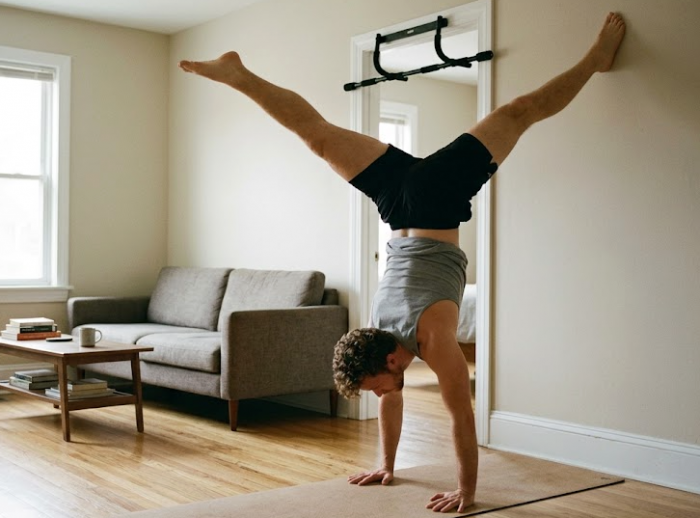
Callisthenics is a form of strength training that uses bodyweight or limited equipment. Workouts are designed to utilise multi-joint movement and functional movements to build flexibility, muscle and endurance. Typically, you can expect to find movements such as push-ups, pull-ups, squats and planks within a callisthenics workout. Unlike traditional strength training, you won’t find weights like dumbbells or resistance machines; callisthenics focuses on gravity and leverage.
Benefits of Callisthenics
- Improved mobility and flexibility: When performing many exercises in a Callisthenics workout, you will need to use your full range of motion. Doing this will help with flexibility and keep your joints agile. Since you will only be using your body weight for resistance, it becomes much easier to perfect form and mobility before scaling.
- Convenience: Callisthenic workouts are convenient for most spaces and people. Specific workouts can be adapted to your skill level and location, meaning you can complete them in your garden or even in a hotel room.
- Cost saving: You don’t need any specific equipment or gym memberships.
- Scalability and intensity: The beauty of Callisthenics is that you can progress movements easily depending on your skill level. Combining movements and introducing transitions or plyometric jumps can add new intensity to the workout.
Common Callisthenics Exercises
Callisthenics is an extremely scalable form of exercise that can be altered to the individual’s skill level. Here are some common callisthenics exercises you will find in workouts, broken down into beginner, intermediate and advanced levels:
| Level | Example Exercises | Focus |
| Beginner | Push-ups, Bodyweight squats, Planks, Lunges | Building a foundational baseline of strength and joint integrity. |
| Intermediate | Pull-ups, Dips, Hanging Leg Raises, Diamond Push-ups | Developing serious upper-body pulling/pushing power. |
| Advanced | Muscle-ups, Handstand Push-ups, Planche, Human Flag | Mastering extreme leverage, balance, and absolute body control. |
How To Progress in Callistenics
Because you aren’t adding weight onto a bar to show progress, skills in callisthenics are often split into ‘Skill Trees’. These progressions often rely on removing points of contact, shifting your centre of gravity or altering your leverage. Let’s walk through some examples of how to progress movements in callisthenics.
1. The Handstand & Vertical Push Tree
| Beginner – Pike Push Ups | Intermediate – Wall-Supported Handstand | Advanced – Freestanding Handstand Push-Up |
| Done on the floor with your hips piped high in the air, mimicking an overhead press. | Building the comfort of being upside down and working on your shoulders. | Complete control of your body alignment while pressing your entire body weight vertically without a wall. |
2. The Planche & Horizontal Push Tree
| Beginner – Planche Lean | Intermediate – Frog Stand | Advanced – Full Planche |
| A standard plank or push-up position where you lean your shoulders past your wrists. | Balancing your body on your hands with your knees resting on your elbows. | Holding your entire body perfectly horizontal, supported only by your hands, with straight arms. |
3. The Muscle-Up & Pulling Tree
| Beginner – Strict Pull Ups /Chest To Bar Pull Ups | Intermediate – The Bar Dip | Advanced – The Strict Muscle Up |
| Building the explosive power and height needed for the transition. | Learning the pushing mechanics required once your torso clears the bar. | Seamless, fluid combination of a powerful pull-up, transition of the wrists and straight bar dip. |
4. The Front Level & Horizontal Pull Tree
| Beginner – Tuck Front Lever | Intermediate – Straddle Front Lever | Advanced – Full Front Lever |
| Hanging from a bar and pulling your hips up so your bar is parallel to the ground, with your knees tucked to your chest. | Extending your legs outwards into a wide V shape. | Holding your entire body completely straight and parallel to the floor. |
5. The Single-Leg (Leg Mastery) Tree
| Beginner – Side Lunges | Intermediate – Assisted Pistol Squat | Advanced – Pistol Squat |
| Developing the deep hip and ankle mobility required for single-leg work. | Lowering down on one leg while holding onto a pole for stability. | A full, freestanding one-legged squat to the floor with the non-working leg out in front. |
FAQS
How many days a week should a beginner perform Callisthenics?
Beginners should train in Callisthenics 2 to 3 days per week, ensuring at least 48 hours of rest between sessions. When starting in Callisthenics, a full-body routine around 3 times a week is optimal.
While your muscles might recover quickly, it is important to allow enough time between sessions to let tendons, ligaments, and joints recover, as common exercises can strain them. Connective tissues adapt much more slowly than muscle tissue, so adequate rest is crucial to prevent overuse injuries.
Callisthenics vs Weightlifting for Muscle Gain: Which is better?
Both types of exercise are effective for building muscle, as hypertrophy relies on mechanical tension, metabolic stress, and progressive overload, not on the source of the resistance.
- Weightlifting makes it much easier and faster to isolate specific muscles and progressively overload the lower body, since you simply add weight to a barbell.
- Callisthenics excels at building a dense, athletic physique, exceptional core strength, and relative strength (how strong you are compared to your body weight).
For absolute muscle mass, weightlifting is slightly more efficient. If your goal is functional strength and body control, Callisthenics wins.
Can I combine Callisthenics and traditional weight training into a single programme?
Absolutely. Combining both of these training methods is called hybrid training and is widely practised and effective.
The most common and efficient way to adopt a hybrid routine is to use weightlifting for your lower body (such as barbell squats and deadlifts, where bodyweight training has limitations) and callisthenics for your upper body skills.
How do you achieve progressive overload in callisthenics without adding weight?
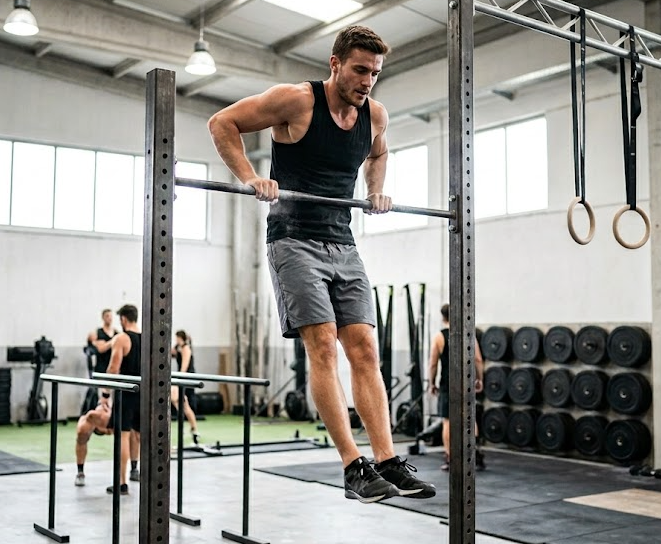
Progressive overload in callisthenics is achieved by altering mechanical leverage, increasing training volume, or adjusting tempo, rather than adding external weight.
To make an exercise harder without weights, you can:
- Change the leverage: Moving from a regular push-up to a pike push-up shifts more body weight onto your shoulders.
- Manipulate time under tension: Slowing down the eccentric (lowering) phase of a pull-up forces the muscle to work harder.
- Reduce points of contact: Moving from a standard squat to a single-leg pistol squat instantly doubles the load on the working leg.
Do I really need zero equipment to start callisthenics?
While you can start callisthenics with absolutely zero equipment, using just the floor, you will eventually need a pull-up bar to ensure a balanced physique.
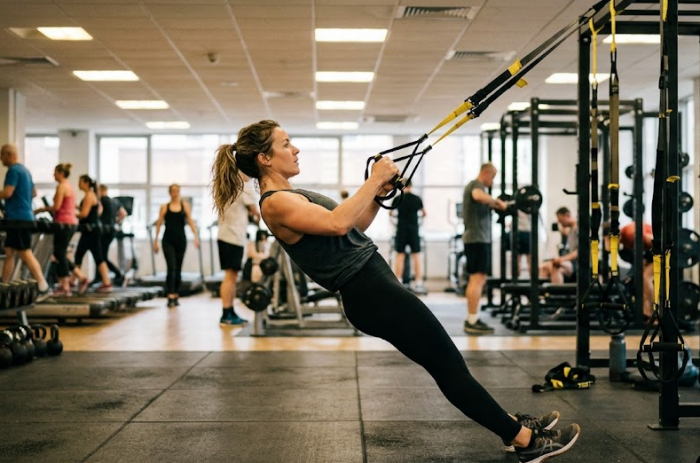
To avoid muscle imbalances (like overdeveloping your chest from push-ups while neglecting your back), you will eventually need a pull-up bar, a set of gymnastics rings, or suspension trainers.
Gymnastics rings are widely considered the ultimate callisthenics tool because their instability forces deep stabiliser muscles to engage, and they can be hung anywhere from a tree branch to a park goalpost.
Why do my joints or wrists hurt during callisthenics, and how can I fix it?
Joint and wrist pain in callisthenics is usually caused by forcing joints through ranges of motion they aren’t adapted to, combined with poor mobility.
Exercises like straight-arm planks, handstands, and deep dips put immense pressure on the wrists and elbows. To fix and prevent this, always include a thorough warm-up for the wrists and shoulders before training.
If a movement hurts, regress to an easier variation (e.g., doing push-ups on your knuckles or using parallettes to keep your wrists straight) and allow your connective tissues time to catch up to your muscle strength.
How long does it take to see results from callisthenics?
You can expect to see improvements in neurological strength and balance within 2 to 4 weeks, while visible muscle growth (hypertrophy) typically takes 8 to 12 weeks of consistent training and proper nutrition.
Because callisthenics relies heavily on the nervous system for coordinating complex movements, your initial “gains” will be skill-based. You will suddenly find yourself able to balance longer or squeeze out two extra pull-ups. Consistent nutrition, a slight caloric surplus (if building muscle), and adherence to your routine are the ultimate keys to long-term visual transformations.
Beginner Callisthenics Routine: Full Body
This routine is designed to be performed 3 days a week with at least one day of rest between sessions. Your main goal here is not to train to absolute failure, but to perfect your form and build joint integrity.
The Warm-Up (5–10 Minutes)
Never skip your warm-up. Callisthenics requires significant joint mobility, especially in the wrists and shoulders.
- Wrist Circles: 10 rotations clockwise and anti-clockwise.
- Arm Swings & Shoulder Dislocates (using a broomstick or band): 15 repetitions.
- Cat-Cow Stretch: 10 repetitions to mobilise the spine.
- Star Jumps: 60 seconds to raise your heart rate.
The Main Workout
Perform this as a traditional set-and-rep routine. Rest for 60 to 90 seconds between sets.
| Exercise | Target Area | Sets x Reps | Coaching Cue / Progression |
| 1. Incline or Standard Push-Ups | Chest, Shoulders, Triceps | 3 x 8–12 reps | Keep your elbows tucked at a 45-degree angle. Don’t let your hips sag. |
| 2. Bodyweight Squats | Quads, Glutes, Hamstrings | 3 x 12–15 reps | Sit back into your heels and drive your knees outwards. Go parallel or lower. |
| 3. Negative Pull-Ups or Australian Rows | Upper Back, Lats, Biceps | 3 x 6–8 reps | If using rows, pull the bar to your lower chest. Keep your body in a straight line. |
| 4. Reverse Lunges | Quads, Glutes, Balance | 3 x 10 reps (per leg) | Step back smoothly. Your back knee should gently graze the floor. |
| 5. Standard Plank | Core, Transverse Abdominis | 3 x 30–45 secs | Squeeze your glutes and press into the floor to engage your upper back. |
The Cool-Down (5 Minutes)
Hold each stretch for 20 to 30 seconds to kickstart recovery and improve flexibility.
- Child’s Pose: Opens up the lats and lower back.
- Doorway Chest Stretch: Relieves tension in the pectoral muscles after push-ups.
- Deep Squat Hold: Sit at the bottom of a squat to relax the hips and ankles.
Common Callisthenics Mistakes and How To Avoid Them
Because callisthenics doesn’t rely on gym machines to guide your movements, it is incredibly easy to cheat your form accidentally.
Here is a quick-reference guide to the most common pitfalls and exactly how to fix them:
| Common Mistake | Why It Stops Your Progress | How To Fix It |
| The Half-Rep (Short range of motion) | Skipping the top or bottom of a movement misses crucial muscle activation and builds incomplete strength. | Prioritise the full range of motion. Leave your ego behind and regress to an easier variation if you cannot lock out. |
| The Sagging Banana (Dropped hips during planks/push-ups) | Deactivates your core and dumps the entire physical load onto your lower lumbar spine, causing back pain. | Master the hollow-body position. Actively squeeze your glutes and tuck your pelvis to keep your body in a rigid line. |
| The Push-Heavy Trap (Neglecting back/pulling work) | Creates severe muscle imbalances, leading to a hunched posture and shoulder impingement. | Maintain a 1:1 ratio. For every pushing set (push-ups/dips), match it with a pulling set (pull-ups/rows). |
| Rushing the Skill Tree (Attempting advanced moves too soon) | Connective tissues (tendons and ligaments) adapt much more slowly than muscle, leading to severe tendonitis. | Respect the timeline. Do not skip ahead to moves like muscle-ups until you have mastered the foundational basics. |
| Kipping & Momentum (Swinging the legs to complete reps) | Removes mechanical tension from the target muscles and puts an erratic, jerky force on your joints. | Practise dead-stop reps. Keep your legs straight, toes pointed, and move slowly using pure muscular control. |
Building a healthy body with FitKit
Callisthenics is more than just a convenient way to break a sweat; it helps you gain flexibility, mobility and strength you can translate into everyday life. Now that you know how to get started, how to scale, and have a workout to attack it, it’s over to you. Is there a specific skill tree you want to conquer?
Check out our full range of functional fitness equipment for any hybrid training needs, and build a body and workout plan you enjoy. We also have a wide range of resources you can explore if you are looking to switch up your training.
Read Next
Comments are closed here.